__________________________________________________________________________________________________________________________

Sunday, April 3, 2011

Important Values of a Margin Calls

Considerations
The important values that trigger a margin call, the margin equity, can change quickly. Assets in the amount of $10,000 purchased with a 50 percent margin loan have a margin equity of $5,000. A maintenance requirement of 25 percent represents a cash value of $2,500.

If the value of the assets declines to $8,000, the outstanding loan is still $5,000, so the margin equity becomes $3,000, and the maintenance level of 25 percent represents $2,000. At a total asset value of $6,000, the equity is only $1,000 but the maintenance level (25 percent of $6,000) is $1,500.

A margin call would be issued to generate the difference. A precipitous decline could cause investors to lose more than their initial investment.

Upon issuing a margin call, a broker usually expects account holders to bring their equity in line with the maintenance level immediately or at least by the end of the trading day.

Though a margin call alerts the account holder to the situation, it doesn't necessarily provide much opportunity to be proactive and prioritize stocks for liquidation. Concurrent with the issuance of a margin call and without warning, the broker can begin to sell assets in the account.


Margin Deals, in finance, transactions in which a purchaser buys securities by paying a percentage of the price and pledging the securities to guarantee payment of the balance of the price.

For example, an investor pays a broker a specified sum (margin) toward the purchase of shares of stock. The broker advances as a loan the remainder of the money needed to purchase the shares.

If the price of the stock remains constant or rises, the broker's loan is protected. If the price begins to fall, the broker notifies the investor that the stock will be sold unless an additional margin is advanced.

One of the worst pieces of news an investor can receive. Not only does it mean the value of his assets has declined, it could mean he has to deposit more money in his trading account. Margin calls are issued by brokers according to the terms of a margin agreement, which specifies the terms by which the broker lends funds to an account holder. The Federal Reserve regulates margin accounts and the terms of a specific margin agreement.

The purpose of a margin call is to inform an account holder that the equity in her stock positions has dropped below the minimum required maintenance level, and to activate certain provisions of the margin agreement. The federal reserve mandates a maintenance level of at least 25 percent, though some brokers set a much higher bar. In response to a margin call, investors must liquidate assets in their account to raise cash or deposit additional funds in their account.

Advantage of Forex Trading

Presently, the FX market is one of the largest and most liquid financial markets in the world, and includes trading between large banks, central banks, currency speculators, corporations, governments, and other institutions.
The average daily volume in the global foreign exchange and related markets is continuously growing. Traditional daily turnover was reported to be over US$3.2 trillion in April 2007 by the Bank for International Settlements.
Since then, the market has continued to grow. According to Euromoney's annual FX Poll, volumes grew a further 41% between 2007 and 2008.

The purpose of FX market is to facilitate trade and investment. The need for a foreign exchange market arises because of the presence of multifarious international currencies such as US Dollar, Pound Sterling, etc., and the need for trading in such currencies.

Although the Forex market is by far the largest and most liquid in the world, day traders have up to now focused on seeking profits in mainly stock and futures markets. This is mainly due to the restrictive nature of bank-offered Forex trading services.

Huge market

Approximately three trillion dollars are being traded everyday in Forex, making it bigger than world stocks, future markets and bonds
Low startup: For trading in Forex, one can begin with as low as 50 dollars

Volatile
It is the most unstable market of the world, which means one gets great opportunities every moment while trading

Low cost
While trading in stock, options and futures, you give commission and spread, with foreign exchange your just cost of trade is spread

No cornering
Unlike the other markets, cornering the foreign exchange market is improbable. Regardless of the total number of people trade with same robot, the profitability and efficiency will remain unharmed, which is a huge plus point

Up and down
Earnings from falling and rising prices, you do not concern the way the market goes and unlike the stock market you need not wait for up tick for shorting.

No size limit

Trade small or big, as per your choice, as Forex trading allows you to trade the way you want.

The forex Trading Method

Forex Annihilation Method

Review I don't know whether you have looked recently, but it has been so obvious over the past year or so that some of the most popular digital information products on the net have been focused on how to make money trading foreign currencies, what is commonly known as Forex trading.

All though, this should not be surprising as many more people everyday are looking for a way of making money online and while some ideas such as setting up an online marketing business might seem difficult and a bit overwhelming, the idea of trading foreign currencies seems simple and easy.

However, the only thing that is easy about Forex trading is making a bad trade because it is possible to lose literally hundreds of dollars within a few minutes if you don't know what you're doing. So, is 'Forex Annihilation Method' just another 'get rich quick and ignore the risks' e-book product like so many of the others seem to be? The answer is categorically no, because 'Forex Annihilation Method' is distinguishable from the majority of other products on the market today.

For a start off, many of the products currently doing the rounds are automated trading systems where the principle idea is that you buy into an automated system that is somehow 'guaranteed' to make thousands of dollars over night. The fact is however that developing a fully automated trading system has long been the 'holy grail' of Forex traders. With the modern computer technology undoubtedly makes it far easier to create such a system, it is a fact that not one of the most successful traders in the history of Forex has ever been able to come up with a perfect system.

Furthermore, using an automatic robot trading system that some programmer has designed means that you do not comprehend the basics of Forex, which is invaluable knowledge if you want to be a Forex success story for many years to come. Here you have the one of the main positive factors of 'Forex Annihilation Method'. It is not an automatic robot, but rather a blueprint to the best known and most effective forex strategies that you can adopt and apply for many years to come, long after the majority of the automated 'trading robot' systems have crashed and burned.

It is a blueprint that draws on over 100 years of expert knowledge and experience to layout and easy to follow, simple trading strategies that are extremely profitable and 100% replicable. Some people liken Forex trading to a way of gambling and whilst this is not a particularly accurate comparison, there is undoubtedly a significant element of risk attached to trading. If you are using an automated robot system, you are allowing someone else to use your money and you have no idea what level of risks they are taking.

But, if you apply your own wisdom to the markets, you control the risks and profits, which is a far more sensible and longer term view approach. Yes, there is good money to be made trading Forex and trading can be a business that supports you for the rest of your life. However, if that is to be the case, you need to learn everything you can and one of the best ways of learning is by research and reading and then applying what you have learned from 'Forex Annihilation Method'.

On the basis of cost versus value for money, 'Forex Annihilation Method' is one of the best investments you can make this year or indeed any year. If you want to become a serious Forex trader, one who makes thousands of dollars of profit from one of the world's most exciting businesses.

The Foreign Exchange Market

Many people are looking at getting into day trading, and start with studying the Stock Market, and the different stock exchanges. What many don't realize is that there are different markets and financial instruments that one can profit from. One market that has recently become available to the public to trade is the Foreign Currency Exchange, the FOREX.

The foreign exchange market is the largest financial market in the world. It trades upwards of 2.5 trillion dollars per day, which is approximately 1000 times the volume of the New York Stock Exchange. Quite easily, the foreign exchange market dwarfs the stock market of any country.

So, where is the foreign currency market? Well, unlike the stock exchanges of the world. The foreign currency market is a virtual market that is connected by the internet, phones, and fax.

The advantage of having a worldwide currency market is that it is open 24 hours a day, 5 days a week. Living in the USA, one could trade 24 hours per day Sunday 5pm to Friday 4pm EST. One can only trade stocks during normal market hours, so for those that have jobs during the day, the FOREX market is much more accessible as trading can be done at night or early in the morning before going to work.

Benefits of the foreign currency exchange

1. High Leverage
Currency brokers usually give their traders 100:1 leverage, meaning that if there is $1000.00 in ones account, they will let one control $100,000.00, which allows currency traders to reap large gains from relatively small price movements in the market.

2. High Liquidity
Because the currency market is the largest market in the world with huge daily volumes, one is always able to get in and out of trades as liquidity is never an issue.

3. Stops are always honored

Except in extremely volatile markets, which is rare, limits and stops are always honored. Because of the market's liquidity and 24 hour continuous trading periods, dangerous trading gaps are eliminated altogether. Orders are executed very quickly, without slippage. In the stock market, it is much more frequent that stops get skipped over as stock prices plummet, but in the FOREX, one can be much more confident that the stops are honored.

4. Entry orders are instant

There is no lag time in placing an order. Orders are processed instantly at the current market price, or the price at which you set the order to enter the market in the future.

5. No Commissions
There are no commissions in currency trading, the broker just takes a small difference between the bid price and the ask price as its fee for the transaction.

As currency markets are some of the most volatile markets, many fundamental variables such as weather, and war affect the price of the currency, however, since there is no one apparent reason much of the time for price movement, the fundamentals get discounted and one can use an almost purely technical approach to trading. This is why the FOREX is considered one of the most predictable trending markets that follows technical analysis methods more than any other market.

As one can see, there are many great benefits to using the FOREX as a highly profitable financial instrument. One can trade from home in their spare time, but first it is important to get a solid education in learning specific FX trading methods. Before trading in a live account, it is important to first get educated using books, or online courses.

There are many courses online selling for upwards of $3000.00, but it is not necessary to spend that kind of money to get a good education. Usually the expensive courses come with DVD's and other expensive items that raise the price. Much of the time one can find a course for under $500 that teaches the exact same content for much less money.

Saturday, April 2, 2011

The Essentials of a Good Strategy

These following points will elaborate what a good strategy is all about.

1. Identify your goals and make them realistic.

2. Fix a time when you will sit down to analyze the market and plan out the trade.

3. Decide when you are going to transact and observe the market.

4. How often are you going to check the market and at what specific times?

5. What's the maximum percentage that you can afford to risk on each transaction?

6. How many lots are you planning to trade?

Reliable Candlestick


How To Spot Four Reliable Candlestick Reversal Patterns

One of the toughest decisions to make while trading is knowing when to sell. Gains can quickly turn into losses because many beginning traders use emotion rather than a system that is developed over time. One of the most reliable ways to protect gains is by learning candlestick reversal patterns. Japanese candlestick charts have been used for hundreds of years to predict commodities markets and in recent history, equities, futures and Forex markets.


The Abandoned Baby
This reversal pattern appears after a strong upward move followed on the second day of little if any movement, either up or down, as bears and bulls struggle for control forming a doji. The third day confirms a sell off as sellers hit the exits forming a long bearish candle. The longer the down candle on the third day, the stronger the confirmation that the uptrend is over.


The Bearish Evening Shooting Star

This formation begins with a move up as buyers jump on with the second day continuing the pattern at the opening bell. However, as the second day progresses, sellers take over pushing the days candle back down to close near where it opened in the morning session. The second day candle is a good indication that the third day will see selling on the open the third day and is confirmed by a closing red candle.


Hanging Man
One of the best indicators to determine the exhaustion of a current upward movement is the hanging man suggesting a candlestick reversal pattern. The day after a move up, the market opens with a strong sell off forming a long shadow with buyers coming in to push the candle above where it opened the session. The hanging man formation is an indication that sellers are gaining in strength and buyers are losing control of the upward move.


Gravestone Doji
The Gravestone Doji is a possible candlestick reversal pattern that shows that there may be weakness in the current uptrend, signaling traders that a reversal may be coming. Buyers continue to push the market higher on day two but sellers have taken over by the time the market closes. A closing red candle on the third day confirms the signal that the current uptrend is broken.

Japanese candlestick charts form many different patterns and learning to read and understand what these formations possibly indicate can mean the difference between winning and losing while trading. Learning to recognize candlestick reversal patterns can help beginning traders learn when to sell at the best possible time, taking indecision out of the equation.

Wednesday, May 12, 2010

Forex Trading Online


FOREX: To Reach You To The Next Level

It is a good idea to get trained on Forex trading online and get tips from people who are experienced in playing the market and willing to share knowledge.

Browse the net for training options on Forex trading online to get your information base on the subject up to date. You can choose live paid sessions that take about four hours a day and involve interactions with experienced Forex traders. You should search for a session in your proximity and register for the session. There is also the option of an online course that will give you a detailed study of the business and have you learn the essentials to make it work for you. It may be worthwhile to invest in a few ebooks as well.

Online Course

Forex trading online.

Online courses may be short, a type of preview about the subject to help you decide whether to go ahead or not. The short courses may involve between seven and ten sessions and involve subjects pertaining to Forex trading online that cover topics like important foreign currency pairs and other major concepts. This type of course is suited for those wanting to know the methods of minimising risk and maximising gain. You will be given a primer on trend analysis and be alert to major international influences that will affect the value of a currency. Economic events, political upheavals, natural calamities and similar circumstances cause the value of the currency to fluctuate. The training will teach you to be alert and anticipate change.

Seminars

Forex trading online.

How about a Forex trading online seminar that helps you to understand the way currency values change and why? In the absence of a local live seminar that you can attend, choose the seminars that take place on the web. These seminars involve an online discussion with a trainer who is experienced in this field. The sessions will vary from 45 to 60 minutes and you are provided the flexibility of attending sessions as per your convenience.

Internet Base Course

Forex Trading online:

Answer your primary questions on Forex trading online by going through the internet and reading a variety of sources that provide basic information about foreign exchange. You will find definitions of commonly used terms, important concepts you should be familiar with and explaining how you should read data pertaining to foreign exchange. Most currencies are quoted considering the US Dollar as the standard; however, there are some countries that do not use this standard. You will not find the reasons this on these courses but when you ask yourself questions that are not easily answered in the material you are using, it is a base for further research.

Choosing Books

Forex trading online.

It is a good idea to invest time and money in a book that provides you with full text regarding the subject of Forex trading online. You can choose from books that explain concepts and give you an overview of the way the business runs worldwide or how to make money when you have entered this field. Some books give you a global overview of the currency market and tell you which country is heading towards a high currency due to its improved business conditions and which is heading downwards due to recessionary trends.

Saturday, April 3, 2010

Modern Portfolio Theory

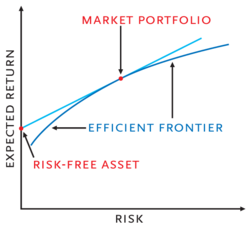
Modern portfolio theory (MPT) is a theory of investment which tries to maximize return and minimize risk by carefully choosing different assets. Although MPT is widely used in practice in the financial industry and several of its creators won a Nobel prize for the theory, in recent years the basic assumptions of MPT have been widely challenged by fields such as behavioral economics.

MPT is a mathematical formulation of the concept of diversification in investing, with the aim of selecting a collection of investment assets that has collectively lower risk than any individual asset. This is possible, in theory, because different types of assets often change in value in opposite ways. For example, when the prices in the stock market fall, the prices in the bond market often increase, and vice versa. A collection of both types of assets can therefore have lower overall risk than either individually.

More technically, MPT models an asset's return as a normally distributed random variable, defines risk as the standard deviation of return, and models a portfolio as a weighted combination of assets so that the return of a portfolio is the weighted combination of the assets' returns. By combining different assets whose returns are not correlated, MPT seeks to reduce the total variance of the portfolio. MPT also assumes that investors are rational and markets are efficient.

MPT was developed in the 1950s through the early 1970s and was considered an important advance in the mathematical modeling of finance. Since then, much theoretical and practical criticism has been leveled against it. These include the fact that financial returns do not follow a Gaussian distribution and that correlations between asset classes are not fixed but can vary depending on external events (especially in crises). Further, there is growing evidence that investors are not rational and markets are not efficient.

Concept

The fundamental concept behind MPT is that the assets in an investment portfolio cannot be selected individually, each on their own merits. Rather, it is important to consider how each asset changes in price relative to how every other asset in the portfolio changes in price.

Investing is a tradeoff between risk and return. In general, assets with higher returns are riskier. For a given amount of risk, MPT describes how to select a portfolio with the highest possible return. Or, for a given return, MPT explains how to select a portfolio with the lowest possible risk (the desired return cannot be more than the highest-returning available security, of course.)

MPT is therefore a form of diversification. Under certain assumptions and for specific quantitative definitions of risk and return, MPT explains how to find the best possible diversification strategy.

Friday, March 5, 2010

Candlestick chart

Candlestick chart patterns are exceedingly popular in forex trading because of their dynamic features and versatility.On all charts, users can toggle between line, bar and candlestick chart view.

Candlestick Charts are usually very colorful charts as compared to conventional charts.

Different colors are used to indicate different nature of price movement.Four prices are of utmost importance in constructing the Candlestick Chart- High, Low, Open, and Close.
Each candle consists of two parts: the body and the shadows.The body reflects the open and closing price for the certain period.If the candle body is black the close price is below the open, and white if the close is higher than the open for the period.

If you think that the candlestick charts are difficult to comprehend you are wrong.All you would need is to learn the means of represent ting the charts in the forex market

Few tips for candlestick charts and their interpretation in the forex market can be:


1. A Black Candlestick -- when the close is lower than the open.
2. A White Candlestick -- when the close is higher than the open.
3. A Shaven Head -- a candlestick with no upper shadow.
4. A Shaven Bottom -- a candlestick with no lower shadow.
5. A Spinning Tops -- an equilibrium between the bulls and the bears (either white or black).
6. A Doji Line - a very close Open and Close?doj.

Friday, July 31, 2009

Mental skills, logics and analytical abilities

Forex: The recipe of success

Everyone, who wishes to achieve a lot in his life, clearly understands, that it is impossible to make your dreams alive without constant improving your skills and widening your outlook. You must always discover something new and be prepared to fast and unpredictable changes. Due to that it is usually said:

"A man, who doesn't risk, doesn't drink champagne".


Today there are so many possibilities of becoming a success, that it's unwise not to use even one of them. Let's take Forex market as an example. That's the real place, where you have a great chance of earning with the use of your mental skills, logics and analytical abilities.


At the same time you should know, that Forex is not a simple game like virtual one called "Monopoly". That's very serious thing and it isn't right place for playing games. The main thing, which success on Forex depends on, is the trader himself. Yes, you are the main part of your trading.

Remember, that you can't achieve any good result if you treat this process not serious. Before beginning the work in the market, you are to ask yourself what do you want to achieve and whether you are ready to risk. There are a lot of people, who are trading on the currency market quite successfully. For some of them Forex trading is the only thing the do for living.

When you are ready with your decision, it's the right time for going to the send step - careful and diligent study. You have to get to know as much as possible. Read books on the topic of Forex (there are o lot of ones nowadays), study the market analysis, analyze the situation on your own and of course, feel free to aks for an advice from more experienced and professional traders.

Be sure, they'll help you. There are a lot of different forums, where you can talk to skilled Forex traders and get answers to all your questions. You can also use Forex Signals. That will help you in working out your own trading system in the future. But notice, that you shouldn't stop your study after achieving some success. Only constant improving your knowledge will keep you up to the mark.

Another important thing to think about before starting is money. Forex is a method of earning money with the use of money. It's some kind of investment. So, with an account of $100 you won't get profits of $1000 in a week.

And finally I'd like to say, that the success on Forex completely depends on the trader's desire to win and his ability to make changes in strategy according to the situation. So, be diligent, efficient and flexible in your trading in order to have big profits.

Wednesday, July 15, 2009

Forex Trading

Structured Freedom For Success In Forex Trading
It's kind of strange in a world with no rule (like forex trading) that it's so important to have a specific set of rules that you follow religiously. I mean let's be honest, trading really doesn't have any rules. You can get in whenever you want. You can get out whenever you want. You can add and subtract to your existing position, and you can obviously decide simply not to trade.

The only thing that could prevent you from participating is the lack of required money to trade. Other than that, you get to decide what you want to do and when you want to do it. If you decide to trade without any rules, I promise you will not be successful. Freedom is good but you need to have what I call a "structured Freedom." Basically, that means you should be able to trade when you want to, but the trades you do need to fall under your set rules.

Rules will help you be more consistent with your trading. They'll help you avoid mental mistakes that can drain your account. About once every six months I write a new set of trading rules for myself. These rules help me to be structured with my trading. And you know, it's the strangest thing, when I have a bad day, it's because I didn't follow one or more of my rules. And of course, the opposite is usually true.

If I've had a good day trading, it is because I did follow my rules. No matter what type of trading you are doing (swing trading, day trading, long-term trading), you'll need to come up with your own set of rules to keep your trading structured. The problem is most people don't want to make up their own rules, because if they if they did they would have to take responsibility for their results. And as we all know, most people don't want to take responsibility for their action.

But as we all know, the only way to be successful in trading is to take 100% responsibility and act in our own best interest.

Examples of my trading rules are as follow;
(1 ).Always use a stop order.
(2.) After 3 losing trades in one day, stop trading.
(3.) If I get 25pips + profits in a trade, I will move my stop to break-even.
(4.) Only use a signal to get into the market. Don't just take a shot.
(5.) Do not trade on holiday type volume. Too slow bad opportunities. Go outside, watch a movie, whatever.
(6.) Always act with your best interest in mind.
(7.) Relax with your trades. If it's not fun and enjoyable, it's not worth doing.
(8.) You don't have to trade everyday.

Those are some of my rules that I use each and everyday, and it's almost automatic. After a bad day trading, I will look at my rules and see that I did not follow them like I should have. And again, the opposite is true. After a good day, I'll look at them and see that I followed them very well. Avoid at all costs getting caught in the trap.

Doing a trade because you are afraid of missing out on a big move is not acting in your best interest. I've got news for you, there are big moves almost everyday.. The more you follow your rules, the more you'll trust yourself and the better your results will be.

Remember, only you are responsible for your trading results, good or bad. Having a set of rules will help you get more good than bad.

By: Timothy Kolawle

Tuesday, June 2, 2009

ETNs Prospect and Conclusion

As a new product, ETN has a very short history. However, it has been growing very rapidly. The ETN represents a nifty product structure that is gaining respect and funding in the market. By 18 July 2006, just one month after the launch of first two ETNs, GSP and DJP, GSP had attracted more than $40 million in assets, and DJP had pulled in more than $130 million for Barclays. Investments in iPath ETNs surpassed $2 billion by late April 2007.

In just over a year Barclays has gathered close to $3 billion in eight funds. Encouraged by the good performance of the ETNs launched by Barclays, other financial institutions have either launched their own products or are drawing plans to partake of the ETN space. We believe more ETNs will be launched to raise more equity for financial institutions. For the customers, the advantages such as tax-efficiency and good liquidity of ETNs will attract more investors to this innovative structured product. All of these imply that ETN is becoming more and more popular.

However, now the question is whether this trend is going to last long. Several industry gurus point to factors that may well dampen the initial euphoria surrounding this product of financial engineering. The lack of historical record – upon which to base their decision to make ETN a part of their portfolio or not – could be keep potential investors at bay.

More importantly, the issuing banks advertise tax-efficiency as ETNs USP. If the IRS rules in the issuers’ favor, the implications of which have been discussed at length in Chapter 3, ETN sales could explode. But what if the IRS delivers an unfavorable word-or never rules? A line of thought that is doing rounds is that even if the IRS delivers an unfavorable word-or never rules at all-the ETNs could still be enormously successful.

The reason is that ETNs provide efficient access to segments of the market that would otherwise be difficult for retail investors to reach. But how could we expect that the investors would still prefer ETNs to ETFs, or any of the multitudes of other structured products out in the market, if there is no tax-efficiency for ETNs. Drawing a comparison to ETFs, another structured product, which suffers from only market risk, ETNs face both counter party risk and market risk. ETNs, bereft of their tax advantage, may lose their shine in the eyes of an entire class of investors.

To conclude, ETNs have performed very well so far as a new kind of structured product with lower fees, better liquidity and tax-efficiency. However, both financial institutes and investors should keep an eye the status of the tax opinion from the IRS on ETNs while seeking ETNs as business or investment possibility.

Structure of ETNs

The returns of ETNs are linked to the performance of a market benchmark or strategy, less investor fees. Currently, there are four types of ETNs, Commodity ETNs, Emerging Market ETNs, Currency ETNs and Strategies ETNs available in the market. (Please refer to Appendix A for a list of available products in each category.)

As discussed previously, ETNs are debt notes. When held to maturity, the investor will receive a cash payment that is linked to the performance of the corresponding index during the period beginning on the trade date and ending at maturity, less investor fees. Typically, ETNs do not offer principal protection.

ETNs could also be liquidated before their maturity by trading them on the exchange or by redeeming a large block of securities directly to the issuing bank. The redemption is typically on a weekly basis and a redemption charge may apply, subjected to the procedures described in the relevant prospectus.

The investor fee is calculated cumulatively based on the yearly fee and the performance of the underlying index and increases each day based on the level of the index or currency exchange rate on that day. Because the investor fee reduces the amount of return at maturity or upon redemption, if the value of the underlying decreases or does not increase significantly, the investor may receive less than the principal amount of investment at maturity or upon redemption.

Since ETNs are unsecured, unsubordinated debts, they are not rated, but are backed by the credit of underwriting banks. Like other debt securities, ETNs do not have voting rights. But unlike other debt securities, interest will not be paid during the term of the most ETNs.

Exchange-Traded Note ( ETN)

An exchange-traded note (or ETN) is a senior, unsecured, unsubordinated debt security issued by an underwriting bank. Similar to other debt securities, ETNs have a maturity date and are backed only by the credit of the issuer.

ETNs are designed to provide investors access to the returns of various market benchmarks. The returns of ETNs are usually linked to the performance of a market benchmark or strategy, less investor fees. When an investor buys an ETN, the underwriting bank promises to pay the amount reflected in the index, minus fees upon maturity. Thus ETN has an additional risk compared to an ETF - upon any reduction of credit ratings or if the underwriting bank goes bankrupt, the value of the ETN will be eroded.

Though linked to the performance of a market benchmark, ETNs are not equities or index funds, but they do share several characteristics of the latter. Similar to equities, they are traded on an exchange and can be shorted. Similar to index fund, they are linked to the return of a benchmark index. But as debt securities, ETNs don't actually own anything they are tracking.

The first ETN, marketed as the iPath Exchange-Traded Notes, was issued by Barclays Bank PLC on 12 June 2006. This was soon followed by Bear Stearns, Goldman Sachs & Swedish Export Credit Corp. In 2008, additional issuers entered the market with their own offerings; these include BNP Paribas, Deutsche Bank, UBS, Lehman Brothers, Morgan Stanley and Credit Suisse. As of April 2008, there were 56 ETNs from nine issuers tracking different indexes.

The popularity of ETNs is mainly due to the advantages that it offers to investors.

Spread Trade

A spread trade refers to the act of buying one security or futures contract and selling another related one, in an attempt to profit from the change in the price difference between the two.

As expiry of a long contract and delivery of the underlying physical commodity approaches, spread trades are used by Index Speculators in commodity futures markets to "roll" their positions out to a later delivery month. Thus, "extinguishing" their open interest in the expiry month while creating new open interest in the later delivery month.

Because they always defer delivery, Index Speculators never take possession of physical inventories and do not operate in the commodity markets with concern for supply and demand- only price movement

Common examples are:

  • Crack spread, between crude oil and gasoline

  • Spark spread, between natural gas and electricity (for gas-fired power stations)

  • Option spread, between the price of two option contracts on the same underlying stock or commodity

  • Calendar spread, between the price of an option or commodity with different expiration/delivery dates.

The margin requirement for a futures spread trade is usually less than the sum of the margin requirements for the two individual futures contracts. Sometimes the margin requirement is even less than the requirement for one of the contracts.